While technology progressed in the first decade of the twentieth century, fashion largely remained the same. Subtle changes in silhouette occurred in womenswear until the tubular shape of the 1910s was beginning to emerge by the end of the decade. Lace and other embellishments were key. Menswear continued to see the suit as the primary style, though the tuxedo became increasingly acceptable as formal wear in the evening. Children continued to be dressed like mini-adults and styles such has the sailor suit continued to be popular options.
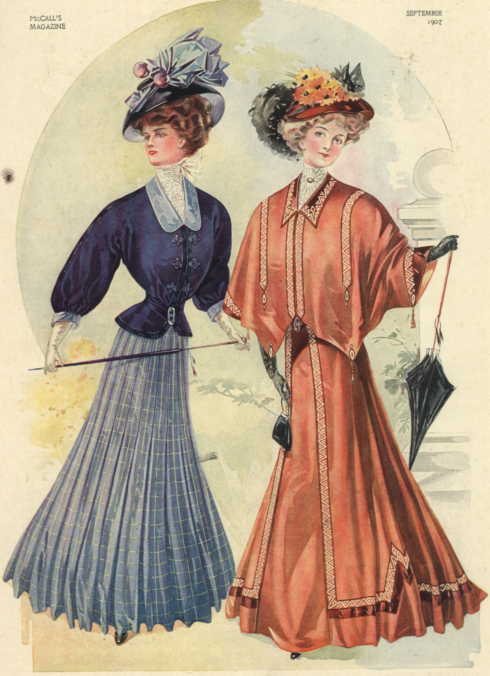
Fashion for women in the first decade of the twentieth century largely followed the fashion of the previous century. The highly structured silhouette of the Gibson Girl was still popular at the beginning of the decade. The simplification and loosening of dress that would come to define the century did not begin to appear until late in the decade and early in the next. Instead, modest dresses, bodies moulded by corsets, and ostentatious ornamentation dominated women’s fashion throughout the first ten years of the century.
For a large part of the decade, the fashionable silhouette continued to be dominated by the S-shape created by a new “health” corset. These corsets pushed the bust forward and the hips back in an attempt to avoid pressure on the abdomen . The shape emphasized a narrow waist and large “mono-bosom,”

Like most of the first half of the twentieth century, men’s fashion moved much slower than women’s. There weren’t great changes to the prevailing menswear modes, but rather subtle changes in details and accessories. What men wore continued to be ruled by the appropriateness for the event and men could wear suits in varying degrees of formality.
Throughout the decade, the most formal option for men was the frock coat during the day and tails in the evening . However, Milford-Cottam comments, “The frock coat was beginning to be thought old-fashioned by 1901, suitable only for Sundays or the most conservative daywear”. During the day, the three-piece suit dominated (Fig. 12), though colors and materials were more varied (though not too daring). Morning dress was worn for the most formal daytime occasions. Neckties were essential and allowed for a small pop of color. Though soft-front shirts were introduced during this period, they would not become widespread until the 1920s. Instead, starched shirt-fronts with high collars were worn with the three-piece suit.
 passion 4 fashion