With the first half of the 1940s dominated by World War II, fashion stalled. Both men and women were often seen in their uniforms during the war and, if they were not, their clothing styles were dictated by rationing and Utility clothing. After the war, Christian Dior launched the New Look in Paris, returning women’s fashion to an overtly feminine silhouette, while men, women, and children’s clothing all began to lean towards the sporty, casual American Look.
The close of the 1930s had brought with it the start of World War II. As World War I had in the 1910s, WWII had a profound impact on fashion in the first half of the 1940s, and even after the war had ended. France, the United Kingdom, and the United States all had distinct fashion stories during the first half of the 1940s due to the impact of the war. After the war, those fashion stories began intersecting again with the arrival of Christian Dior’s New Look.
By the dawn of the 1940s, France had long been established as the center of women’s fashion design. However, just six months into 1940, German forces occupied Paris, an occupation that would last until late 1944. While some designers left Paris at the start of the occupation, many stayed and continued to design . Because France was cut off from the US and the UK, these designs were not seen outside of France and diverged drastically from what other countries were wearing. This difference can be seen as early as 1940 as the Bergdorf Goodman sketches by American designer Philip Hulitar show a much sleeker silhouette than the full-skirted wedding ensemble by French designer Jeanne Lanvin .

Just as World War II stalled women’s fashion, it also slowed change in men’s fashion. Rationing, of course, affected all ages and genders indiscriminately and Utility suits were created for men as well. With so many men going to war or doing their part at home, it was more unusual to see men out of uniform than it was to see them in it. As such, men’s fashion remained largely the same as it had been in the late 1930s throughout the first half of the forties, with new Utility styles changing primarily to accommodate the use of less material.
While women’s Utility clothing was designed by established designers like Claire McCardell in the US and Norman Hartnell in the UK, men’s Utility clothing was marked by its pared-down look rather than its fashion credentials.

1950-1959
Fashion in the 1950s saw a clear gender divide. While men and boy’s fashion moved towards a more casual day-to-day style, women and girl’s fashion prioritized elegance, formality, and perfectly matched accessories. Couture womenswear saw rapid change with new designers such as Cristobal Balenciaga and Hubert de Givenchy disrupting the overtly feminine silhouette popularized by Christian Dior while novel prints and colors marked a playfulness in fashion for both men and women.
Fashion is rarely contained neatly in one decade, and the popular look that dominated womenswear in the 1950s actually emerged in the late 1940s. When Christian Dior’s “New Look” appeared in February 1947, it became an instant success and the nipped-in waist and full-skirted silhouette remained the leading style until the mid-1950s. As the decade progressed, the dominant silhouette became progressively straighter and slimmer, and as fashion began to look to the new “teenager” for inspiration, the elegance and formality of the early part of the decade began to lessen.
As the 1950s began, the initial resistance to the extravagance of the New Look had died down and the silhouette was entrenched in both women’s daywear and eveningwear. Dior himself continued to produce designs that followed the feminine line even while incorporating new elements, like the structural collar.

MENSWEAR
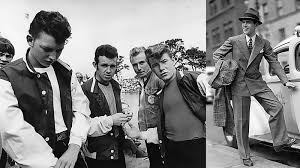
Although womenswear in the 1950s prided formality, men’s fashion moved towards an informality it had not yet seen before. Though young women wore tight sweaters and sought clothes that suited her age, it was young men who really started the so-called “youth culture” of the 1950s. Since the rise of the suit in the 18th century, men’s fashion had seen little dramatic change until the rise of the Teddy Boys in Britain and the rebellious youths who looked to Hollywood stars Marlon Brando and James Dean in the fifties. Significantly, both of these styles were adopted or inspired by working-class men, rather than coming from the elite.
In the years after World War II, tailors on Savile Row in London introduced a slim cut suit with a velvet-collared suit that was referred to as the New Edwardian . While it was originally elegant, upper-class men who wore these suits with narrow trousers, in the early 1950s, young working-class men began to adopt and adapt the style for their own purposes. Nicknamed “Teddy Boys” (Teddy being a nickname of Edward), these young men, wore extremely narrow trousers, velvet-collared jackets and greased their hair back into quiffs. While the style was popular and signified a certain type of rebellious young working-class man, it also signified a shift in the ability of the working-class young to consume.
 passion 4 fashion