Fashion in the 1960s became progressively more casual across all genders and ages. Womenswear followed three broad trends: a continuation of the previous decade’s ladylike elegance, the youthful styles of Mary Quant and the Space Age influence, and the late 1960s “hippie” style. Menswear saw an increasing amount of color and pattern, military influence, and new fashion icons in the form of rock stars. Children’s wear saw less change, but also became more casual and bright in color and pattern.
roadly categorized, there were three main trends in 1960s womenswear: 1) the lady-like elegance inherited from the previous decade seen on the likes of First Lady Jacqueline Kennedy, 2) the fun, youthful designs popularized by Swinging London, and 3) the Eastern-influenced hippie styles of the late 1960s. Along with these diverse styles, there came a shift in the way that women shopped and for whom the styles were created.
In the early years of the decade, fashion continued along the lines of the 1950s. Skirt suits and coordinating accessories were emphasized as one decade transitioned into the next. First Lady Jacqueline Kennedy epitomized this look during her husband’s presidential campaign and short presidency. She was admired around the world for her put-together, lady-like look consisting of boxy skirt-suits like the Givenchy suit and navy suit in , sheath and A-line dresses , and luxurious coats–all accessorized with white gloves, pearls, and a matching hat. This look was being produced by the likes of Hubert de Givenchy and Cristóbal Balenciaga , but as the decade progressed, it became clear that the momentum was towards a new kind of designer in the 1960s.

MENSWEAR
Just as womenswear became more casual and colorful throughout the 1960s, so too did menswear. While menswear began moving towards a more casual style in the 1950s, the frenetic energy of Swinging London found its way with bright prints and colors for men. As there had not been very much movement in men’s fashion for over a hundred years, the change was striking. The V&A writes,
“Perhaps the most remarkable development in 1960s dress was the dramatic change in menswear. For the past 150 years, clothing for men had been tailor-made, and plain and sombre in appearance. Now, colourful new elements were introduced, such as the collarless jacket, worn with slim-fitting trousers and boots” (History of Fashion 1900-1970).
The V&A
Where the mid- to late-1950s saw a rise in the popularity of Italian style suits with narrow striped ties, menswear gradually incorporated brighter colors and patterns, and ties began to widen again as the decade progressed. The difference between the conventional suit seen in 1963 and those designed by Cardin and worn by George Harrison is striking.

1970-1979
Seventies fashion saw bold colors and patterns take center stage. Women’s fashion looked back to the 1940s by day and pumped up the glamour by night. Men had an array of suit types to choose from and favored colorful plaids. Children’s fashion followed adult fashion with bold plaids and bright colors with the distinction between genders lessening throughout the decade.
WOMENSWEAR
As the Swinging Sixties turned into the 1970s, the influence of boutique stores and diffusion lines made ready-to-wear clothing increasingly accessible. New synthetic fabrics meant that fashionable styles could be bought at any price point. So pervasive were these materials that the seventies became known as the “Polyester Decade.” The decade saw a wide range of popular styles: from the early prairie dresses influenced by hippie fashion, to the flashy party wear worn to disco nightclubs, to the rise of athletic wear as the decade looked towards the 1980s, the seventies was a decade that explored fashion, but also looked back.
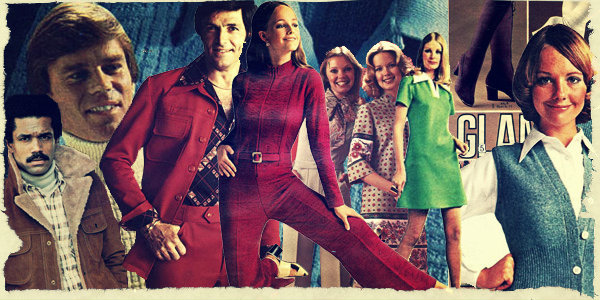
Seventies fashion began with a continuation of the late 1960s hippie style. In the early 1970s, this meant an emphasis on handmade materials and decorations. While the hippies of the sixties had embraced these items as a way of rejecting mainstream fashion, designers in the early seventies began to incorporate them into their high fashion collections. Patchwork, crochet and knitting, embroidery were among the details used by designers. The silk evening gown by Zandra Rhodes shows how patterns and the loose, flowing quality of the hippie style crept into high fashion . “Quilting, felting, dyeing, beading, smocking, leather craft and hand-painted fabrics were also reclaimed from craft fairs for the fashion world,” says Daniel Milford-Cottam in Fashion in the 1970s . The styles from Seventeen magazine show an influence from homemade crafts in the embroidered patterns while being made in the decade’s signature polyester

MENSWEAR
Men’s fashion in the 1970s continued to get brighter and bolder. By the early seventies, the so-called “Peacock Revolution” that had started in the 1950s had made it acceptable for men to wear brighter colors, bolder prints and wear their hair long. While the suit continued to be a staple for many men, new, inventive styles were popularized.
In the early 1970s, men’s fashion tried to emphasize a tall, lean figure. Turtlenecks, slim-fitting shirts, and tight-fitting flared pants all worked to popularize the silhouette. Milford-Cottam writes,
“Wide belts with large buckles focused the eye on the centre of the torso, making broader bodies appear slimmer. Over the top, a sleeveless waistcoat or jerkin, a classic single-breasted sports jacket in tweed, denim, or corduroy, or a blouson jacket in leather or synthetic fabric was usually worn” (37).
Milford-Cottoam
 passion 4 fashion