The 2000’s

The Early 2000’s

Technology and Y2K had a huge impact on fashion in the early 2000s. The color palette was filled with shiny black tones and reflective metallics. While some Y2K trends were worn daily, many of these looks were reserved for going out. Popular outfits for women included mesh or handkerchief tops, box-pleated or leather skirts, shiny pants, and sparkly shoes. For men, Y2K looks usually involved leather jackets, a statement dress shirt, and chunky shoes. If you need inspiration, Britney Spears and *NSYNC were trendsetters for this type of style.

Casual clothing and leisurewear were the other big trends of the early 2000s. Denim became a staple for men and women, going beyond jeans to shirts, jackets, and hats. If you’re putting together a casual style for women, think crop tops, hoodies, low-rise flared jeans, cargo pants, daisy dukes, jean skirts, off the shoulder tops, ribbed sweaters, with platform sandals, Ugg boots, or sneakers. Common looks for men included, distressed denim, cargo pants, tracksuits, rugby or polo shirts, flip flops, oxford shoes, and sneakers.

Mid 2000s fashion


As the decade went on, 2000s fashion began to take cues from 1960s bohemian looks. Yoga pants, low-rise jeans, cowl-neck shirts, peasant tops, capri pants, cropped jackets, and dresses over jeans were popular outfit choices for women. These were often paired with accessories like chunky belts, aviator sunglasses, jelly bracelets, ties worn around the neck or as belts, ballet flats, and platform boots.

The 1960s revival looks were also popular with men. Outfit options included light wash bootcut jeans, cargo shorts, classic rock t-shirts, fitted cowboy shirts, henleys, polos with popped collars, and seersucker suits.

The middle of the decade was also defined by the latest “it” items, like Von Dutch trucker hats, Juicy Couture tracksuits, and Louis Vuitton bags.

That’s So Raven, The OC, Charmed.

Late 2000s fashion

Many styles from the early and mid-2000s carried over to the latter part of the decade, with a few exceptions. For women, crop tops were replaced with camisoles and miniskirts gave way to babydoll, bubble skirt, and sweater dresses. There was also a 1980s and 1990s revival that reintroduced neon colors, animal prints, geometric shapes, light denim jeggings, and ripped acid washed jeans that were worn with gladiator sandals, ballet flats, and headbands. An oversized look started to gain popularity, but it was subtler than the traditional ’80s fit.

Men’s late 2000s fashion was a mix of 1950s and 1980s throwbacks, with letterman and black leather jackets, overcoats, slim cut jeans, Ed Hardy t-shirts, flannel shirts, and V-neck sweaters. These were often paired with dad hats, wayfarers or aviators, motorcycle boots, Converse, Vans, or sneakers. The men’s power suit was also updated from the ’80s to have more a slim tailored cut.

Late 2000s fashion
Hannah Montana (Disney) | Ugly Betty (ABC) | Gossip Girl (The CW)

A Recap For The Ages

Here is a little video to show you the fashion timeline

1980-1999

WOMENSWEAR

The 1980s birthed more fashion icons than any other decade.

Along with 1970s fashion, 1980s fashion was one of the most experimental periods in style history thanks to enduring style icons from Princess Diana to Madonna, Joan Collins to Boy George.

Clothes were used to define personalities and make big statements. Shoulders were padded right up to your ears, courtesy of Lady Diana and the cast of Dynasty. Meanwhile Boy George and the Blitz club crew were giving peacock punk a whirl. No doubt about it, it was a crazy era for all things à la mode – the later 1990s fashion was significantly calmer by comparison. Let’s take a look back.Our beloved Madge burst onto the pop scene in 1983, working haute scrunchies, leathers and tutus like we’d never seen before. We fell in love (naturally) and the queen of pop reigned on for the rest of the decade, breaking style boundaries with her incredible physique and conical bras.

It would be silly of us to even try to sum up Princess Diana’s impact on fashion and culture in one short paragraph, but if we had to, we would say this: she was the trendsetter of a generation, a champion of the power shoulder and that super eighties wedding dress, which literally went down as one of the biggest in history.This jacket is exactly what 1980s fashion was all about. The power jacket became a Michael Jackson style signature and one of the most copied cuts of the decade. This iconic piece went on to sell for $1.8million at auction in 2011, described by its new owner as ‘the greatest piece of rock memorabilia ever’. Enough said.Joan Collins. The queen of 80s TV show Dynasty inspired thousands of big hair ‘dos and heavy make-up statements throughout the decade. Her character, the soap’s villain Alexis Colby, had a wardrobe of puff shoulder dresses and trophy jackets that was so bad, it was so so good.From The Breakfast Club to Pretty In Pink, the Brat Pack dominated the decade’s teen movies, with one idol always stealing the show as the prettiest, most popular girl in school. Oh come on, don’t pretend you didn’t want to be her

Homemade jewelry and, to a lesser degree, self-designed clothing, was very popular.AdvertisementBy then, the eighties had become a bad thing. Hair spray was eighties. Too much makeup was eighties. Flashy clothing was eighties. Anything eighties was considered a bad thing. Most women didn’t want wild patterns and colors, they wanted simple and humble. Solid colors, preferably subdued was the way to go.

As the decade progressed, fashion became more similar to what you saw throughout the 2000s. The grunge look faded away and sexy made a comeback. Tight clothing was worn again and glamour was ever slowly inching its way back into the fashion world. Which was great news for fashion designers, who had grown tired trying to make flannel look good.

1960-1979

Fashion in the 1960s became progressively more casual across all genders and ages. Womenswear followed three broad trends: a continuation of the previous decade’s ladylike elegance, the youthful styles of Mary Quant and the Space Age influence, and the late 1960s “hippie” style. Menswear saw an increasing amount of color and pattern, military influence, and new fashion icons in the form of rock stars. Children’s wear saw less change, but also became more casual and bright in color and pattern.

roadly categorized, there were three main trends in 1960s womenswear: 1) the lady-like elegance inherited from the previous decade seen on the likes of First Lady Jacqueline Kennedy, 2) the fun, youthful designs popularized by Swinging London, and 3) the Eastern-influenced hippie styles of the late 1960s. Along with these diverse styles, there came a shift in the way that women shopped and for whom the styles were created.

In the early years of the decade, fashion continued along the lines of the 1950s. Skirt suits and coordinating accessories were emphasized as one decade transitioned into the next. First Lady Jacqueline Kennedy epitomized this look during her husband’s presidential campaign and short presidency. She was admired around the world for her put-together, lady-like look consisting of boxy skirt-suits like the Givenchy suit and navy suit in , sheath and A-line dresses , and luxurious coats–all accessorized with white gloves, pearls, and a matching hat. This look was being produced by the likes of Hubert de Givenchy and Cristóbal Balenciaga , but as the decade progressed, it became clear that the momentum was towards a new kind of designer in the 1960s.

1960-1969
1960

MENSWEAR

Just as womenswear became more casual and colorful throughout the 1960s, so too did menswear. While menswear began moving towards a more casual style in the 1950s, the frenetic energy of Swinging London found its way with bright prints and colors for men. As there had not been very much movement in men’s fashion for over a hundred years, the change was striking. The V&A writes,

“Perhaps the most remarkable development in 1960s dress was the dramatic change in menswear. For the past 150 years, clothing for men had been tailor-made, and plain and sombre in appearance. Now, colourful new elements were introduced, such as the collarless jacket, worn with slim-fitting trousers and boots” (History of Fashion 1900-1970).

The V&A

Where the mid- to late-1950s saw a rise in the popularity of Italian style suits with narrow striped ties, menswear gradually incorporated brighter colors and patterns, and ties began to widen again as the decade progressed. The difference between the conventional suit seen in 1963 and those designed by Cardin and worn by George Harrison is striking.

Image result for 1960 fashion trends men
1960

1970-1979

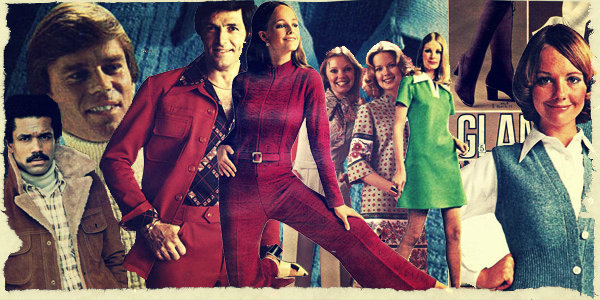
Seventies fashion saw bold colors and patterns take center stage. Women’s fashion looked back to the 1940s by day and pumped up the glamour by night. Men had an array of suit types to choose from and favored colorful plaids. Children’s fashion followed adult fashion with bold plaids and bright colors with the distinction between genders lessening throughout the decade.

WOMENSWEAR

As the Swinging Sixties turned into the 1970s, the influence of boutique stores and diffusion lines made ready-to-wear clothing increasingly accessible. New synthetic fabrics meant that fashionable styles could be bought at any price point. So pervasive were these materials that the seventies became known as the “Polyester Decade.” The decade saw a wide range of popular styles: from the early prairie dresses influenced by hippie fashion, to the flashy party wear worn to disco nightclubs, to the rise of athletic wear as the decade looked towards the 1980s, the seventies was a decade that explored fashion, but also looked back.

Seventies fashion began with a continuation of the late 1960s hippie style. In the early 1970s, this meant an emphasis on handmade materials and decorations. While the hippies of the sixties had embraced these items as a way of rejecting mainstream fashion, designers in the early seventies began to incorporate them into their high fashion collections. Patchwork, crochet and knitting, embroidery were among the details used by designers. The silk evening gown by Zandra Rhodes shows how patterns and the loose, flowing quality of the hippie style crept into high fashion . “Quilting, felting, dyeing, beading, smocking, leather craft and hand-painted fabrics were also reclaimed from craft fairs for the fashion world,” says Daniel Milford-Cottam in Fashion in the 1970s . The styles from Seventeen magazine show an influence from homemade crafts in the embroidered patterns  while being made in the decade’s signature polyester

1970-1979
A couple photographed at their wedding in 1973

MENSWEAR

Men’s fashion in the 1970s continued to get brighter and bolder. By the early seventies, the so-called “Peacock Revolution” that had started in the 1950s had made it acceptable for men to wear brighter colors, bolder prints and wear their hair long. While the suit continued to be a staple for many men, new, inventive styles were popularized.

In the early 1970s, men’s fashion tried to emphasize a tall, lean figure. Turtlenecks, slim-fitting shirts, and tight-fitting flared pants all worked to popularize the silhouette. Milford-Cottam writes,

“Wide belts with large buckles focused the eye on the centre of the torso, making broader bodies appear slimmer. Over the top, a sleeveless waistcoat or jerkin, a classic single-breasted sports jacket in tweed, denim, or corduroy, or a blouson jacket in leather or synthetic fabric was usually worn” (37).

Milford-Cottoam
Image result for 1970 fashion trends women and men

1940-1959

With the first half of the 1940s dominated by World War II, fashion stalled. Both men and women were often seen in their uniforms during the war and, if they were not, their clothing styles were dictated by rationing and Utility clothing. After the war, Christian Dior launched the New Look in Paris, returning women’s fashion to an overtly feminine silhouette, while men, women, and children’s clothing all began to lean towards the sporty, casual American Look.

The close of the 1930s had brought with it the start of World War II. As World War I had in the 1910s, WWII had a profound impact on fashion in the first half of the 1940s, and even after the war had ended. France, the United Kingdom, and the United States all had distinct fashion stories during the first half of the 1940s due to the impact of the war. After the war, those fashion stories began intersecting again with the arrival of Christian Dior’s New Look.

By the dawn of the 1940s, France had long been established as the center of women’s fashion design. However, just six months into 1940, German forces occupied Paris, an occupation that would last until late 1944. While some  designers left Paris at the start of the occupation, many stayed and continued to design . Because France was cut off from the US and the UK, these designs were not seen outside of France and diverged drastically from what other countries were wearing. This difference can be seen as early as 1940 as the Bergdorf Goodman sketches by American designer Philip Hulitar show a much sleeker silhouette than the full-skirted wedding ensemble by French designer Jeanne Lanvin .

Image result for 1940 fashion trends women
Three woman photographed in 1944


Just as World War II stalled women’s fashion, it also slowed change in men’s fashion. Rationing, of course, affected all ages and genders indiscriminately and Utility suits were created for men as well. With so many men going to war or doing their part at home, it was more unusual to see men out of uniform than it was to see them in it. As such, men’s fashion remained largely the same as it had been in the late 1930s throughout the first half of the forties, with new Utility styles changing primarily to accommodate the use of less material.

While women’s Utility clothing was designed by established designers like Claire McCardell in the US and Norman Hartnell in the UK, men’s Utility clothing was marked by its pared-down look rather than its fashion credentials. 

Image result for 1940 fashion trends men
Five men in an illustrated magazine

1950-1959

Fashion in the 1950s saw a clear gender divide. While men and boy’s fashion moved towards a more casual day-to-day style, women and girl’s fashion prioritized elegance, formality, and perfectly matched accessories. Couture womenswear saw rapid change with new designers such as Cristobal Balenciaga and Hubert de Givenchy disrupting the overtly feminine silhouette popularized by Christian Dior while novel prints and colors marked a playfulness in fashion for both men and women.

Fashion is rarely contained neatly in one decade, and the popular look that dominated womenswear in the 1950s actually emerged in the late 1940s. When Christian Dior’s “New Look” appeared in February 1947, it became an instant success and the nipped-in waist and full-skirted silhouette remained the leading style until the mid-1950s. As the decade progressed, the dominant silhouette became progressively straighter and slimmer, and as fashion began to look to the new “teenager” for inspiration, the elegance and formality of the early part of the decade began to lessen.

As the 1950s began, the initial resistance to the extravagance of the New Look had died down and the silhouette was entrenched in both women’s daywear and eveningwear. Dior himself continued to produce designs that followed the feminine line even while incorporating new elements, like the structural collar. 

Image result for 1950 fashion trends women
A Magazine illustration showing the range of clothes offered in 1950’s

MENSWEAR

Although womenswear in the 1950s prided formality, men’s fashion moved towards an informality it had not yet seen before. Though young women wore tight sweaters and sought clothes that suited her age, it was young men who really started the so-called “youth culture” of the 1950s. Since the rise of the suit in the 18th century, men’s fashion had seen little dramatic change until the rise of the Teddy Boys in Britain and the rebellious youths who looked to Hollywood stars Marlon Brando and James Dean in the fifties. Significantly, both of these styles were adopted or inspired by working-class men, rather than coming from the elite.

In the years after World War II, tailors on Savile Row in London introduced a slim cut suit with a velvet-collared suit that was referred to as the New Edwardian . While it was originally elegant, upper-class men who wore these suits with narrow trousers, in the early 1950s, young working-class men began to adopt and adapt the style for their own purposes. Nicknamed “Teddy Boys” (Teddy being a nickname of Edward), these young men, wore extremely narrow trousers, velvet-collared jackets and greased their hair back into quiffs. While the style was popular and signified a certain type of rebellious young working-class man, it also signified a shift in the ability of the working-class young to consume.

Image result for 1950 fashion trends men
The different styles in the 1950’s for men

1920-1939

At the dawn of the 1920s, the world was still reeling from the First World War. The conflict, which ended just over a year before the new decade began, had a fundamental and irreversible effect on society, culture, and fashion. Essential to these new styles was a simplicity that had not previously been seen in women’s fashion.This simplicity created the popular tubular “la garçonne” look that dominated much of the decade. Also known as the flapper, the look typified 1920s dress with a dropped waist and creeping hemlines that could be created in economical fabrics. Coco Chanel helped popularize this style and was a prominent designer during the period. Both waistlines and hemlines followed similar, though inverse, projections throughout the decade, as waistlines dropped until 1923 before beginning to rise again in 1928; while hemlines rose until 1926, when they started to fall again.

Image result for 1920 fashion trends women
A man and woman photo in 1920

MENSWEAR

As womenswear valued simplicity in the 1920s so, too, did menswear. Men moved away from starched collars and formal three-piece suits during the day. Instead, they adopted soft collars and one- or two-button suit jackets often worn without a waistcoat as seen in the different styles shown on the fashion plate. Pinstripes were popular, as were British wools and English tailoring. Martin Pel writes that “British men were perceived to be sartorially the most elegant, and fashionable men hoped to emulate the style and heritage of Savile Row and the English elite” . Popular materials were tweeds and flannels, depending on the season.

1930-1939

In the 1930s, fashion saw a profound influence from films and specifically Hollywood. Men’s, women’s, and children’s styles were based on fashions seen on screen with stars like Clark Gable, Jean Harlow, and Shirley Temple among the many who directly influenced fashion. A return to conservatism after the Roaring Twenties also marked fashion during this period.

s the 1920s turned into the 1930s, women’s fashion softly evolved from the boyish look of the previous decade into the feminine silhouette of the early thirties. With the stock market crash in 1929 and with the opening of the new decade, hemlines descended back to ankle length and waistlines moved back to their natural place.

Despite these departures from the prevailing mode of the previous decade, the popular styles of the early 1930s were similar in their simple lines to the popular garçonne look of the twenties. But while the simplicity of the 1920s created a sack-like silhouette free from curves, the simple lines of the early thirties hugged those curves, creating a soft, feminine silhouette. 

Image result for 1930 fashion trends women
Man and Woman photographed in 1935

Like womenswear, menswear saw a shift of focus to the movies for fashion inspiration in the 1930s. Just as women’s fashion had begun to democratize in the twenties, men’s fashion followed suit. Fashion writer Colin McDowell writes in The Man of Fashion: Peacock Males and Perfect Gentlemen of the power movies had over men’s fashion in the thirties, recalling that sales of undershirts slumped when Clark Gable , revealed that he wasn’t wearing one in 1934’s It Happened One Night (111).

1900-1910 the fashion

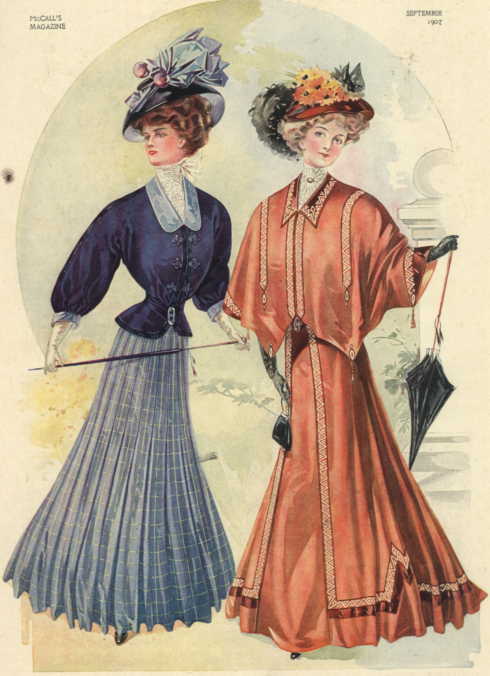
While technology progressed in the first decade of the twentieth century, fashion largely remained the same. Subtle changes in silhouette occurred in womenswear until the tubular shape of the 1910s was beginning to emerge by the end of the decade. Lace and other embellishments were key. Menswear continued to see the suit as the primary style, though the tuxedo became increasingly acceptable as formal wear in the evening. Children continued to be dressed like mini-adults and styles such has the sailor suit continued to be popular options.

Image result for 1900 fashion trends
women in 1900

Fashion for women in the first decade of the twentieth century largely followed the fashion of the previous century. The highly structured silhouette of the Gibson Girl was still popular at the beginning of the decade. The simplification and loosening of dress that would come to define the century did not begin to appear until late in the decade and early in the next. Instead, modest dresses, bodies moulded by corsets, and ostentatious ornamentation dominated women’s fashion throughout the first ten years of the century.

For a large part of the decade, the fashionable silhouette continued to be dominated by the S-shape created by a new “health” corset. These corsets pushed the bust forward and the hips back in an attempt to avoid pressure on the abdomen . The shape emphasized a narrow waist and large “mono-bosom,” 

Image result for 1900 fashion trends men
three men in 1900

Like most of the first half of the twentieth century, men’s fashion moved much slower than women’s. There weren’t great changes to the prevailing menswear modes, but rather subtle changes in details and accessories. What men wore continued to be ruled by the appropriateness for the event and men could wear suits in varying degrees of formality.

Throughout the decade, the most formal option for men was the frock coat during the day and tails in the evening . However, Milford-Cottam comments, “The frock coat was beginning to be thought old-fashioned by 1901, suitable only for Sundays or the most conservative daywear”. During the day, the three-piece suit dominated (Fig. 12), though colors and materials were more varied (though not too daring). Morning dress was worn for the most formal daytime occasions. Neckties were essential and allowed for a small pop of color. Though soft-front shirts were introduced during this period, they would not become widespread until the 1920s. Instead, starched shirt-fronts with high collars were worn with the three-piece suit.

My First Post the fashion timeline

Hello this my first very post about fashion and I would like to start from the 1700’s as their choice of fashion intrigues me as their decade was famous for hoop skirts and corsets.Fashion in the period 1700–1750 in European and European-influenced countries is characterized by a widening silhouette for both men and women following the tall, narrow look of the 1680s and 90s. Wigs remained essential for men of substance, and were often white; natural hair was powdered to achieve the fashionable look. Distinction was made in this period between full dress worn at court and for formal occasions, and undress or everyday, daytime clothes. As the decades progressed, fewer and fewer occasions called for full dress, which had all but disappeared by the end of the century.

Image result for 1700s fashion for women and men"
men and women fashion styles

In the 1750’s the fashion changed but not drastically. Women: Court dress included elaborate and intricate styles influenced by Rococo; hoop skirts; panniers; corsets; petticoats; stays; conical torso shape with large hips; “standardized courtly bodies and faces” with little individuality.

1750-1759
painting in 1750


The 1890s were a period of change. As the century drew to a close, the world began to move away from the stiff, moralistic, Victorian Era (Laver 211). Urban centers were growing, and new technologies, such as the introduction of electricity into clothing manufacturing, produced a boom in the ready-to-wear market. Women were enjoying new levels of independence; during the decade the number of women employed outside the home almost doubled (Tortora 380-382). The “New Woman” of the era was an intellectual young female who worked, cycled, and played sports. Dress historian James Laver wrote:“The old, rigid society-mould [sic] was visibly breaking up… For the young, there was a new breath of freedom in the air, symbolized both by their sports costumes and by the extravagance of their ordinary dress. It was perfectly plain that the Victorian Age was drawing to its close.” (211)

1890-1899
A photo taken in 1890 of three woman with bicycles
Create your own website, free on WordPress.com.Create your own website.
Start free